Showing posts with label saxofón. Show all posts

Tuesday, May 5, 2009

James Carter - J C on the set


James carter is a throwback to the days when saxophonists walked with a certain swagger, had their own signature sounds and didn't need microphones to be heard. What makes his debut, JC on the Set, so remarkable is not a matter of chops but of depth. Carter has a conspicuous gift for the entire post-Coltrane jazz vocabulary and a genuine affection for pre-Charlie Parker saxophone techniques, too.

In fact, Carter seems to play the entire history of the saxophone within a single solo. With unflagging lyricism and commanding sound, he takes flag-waving lines like those in "Baby Girl Blues" or "Lunatic" and evokes the dueling saxophones of a thousand cutting sessions. The effect can be daunting, as he crowds idea upon idea like a crush of blood cells trying to squeeze through one capillary. It is a youthful shortcoming for an such an uncommonly mature musician, but it never undercuts the power of this record, as Carter shows prodigious emotional facility, muscular tone and a stunning sense of swing on tenor, baritone and alto.

Carter covers the Ellington standards "Caravan" and "Sophisticated Lady" on baritone – the latter all suave elegance and lyric restraint, the former visceral, gusty and free – and he suggests the entire Ellington reed section all by his lonesome. On "Hour of Parting" he invokes the pear-shaped romantic inflection of alto giants Benny Carter and Johnny Hodges, while his rendition of unsung tenor giant Don Byas' "Worried and Blues" is husky yet tender in the macho tradition of Coleman Hawkins and his children.

As a composer, James Carter favors the tenor's heraldic blues legacy. On the title tune and "Blues for a Nomadic Princess" he employs old-time slap-tonguing effects one minute and then ascends into the stratosphere with fervent chromatic cries the next – from swing time to no time and back with no loss of focus.

Carter's band is excellent, playing with tremendous grace and integrity. While JC on the Set is an imposing debut, it will be fascinating to see how Carter evolves. But even at this early stage in his development, Carter is the most exciting young saxophonist to arrive on the scene in the past 25 years.

Download:

Music

Discography

* 1991: Tough Young Tenors: Alone Together
* 1994: J.C. on the Set
* 1995: Jurassic Classics
* 1995: The Real Quietstorm
* 1996: Conversin' with the Elders
* 1998: In Carterian Fashion
* 2000: Layin' in the Cut
* 2000: Chasin' the Gypsy
* 2003: Gardenias for Lady Day
* 2004: Live at Baker's Keyboard Lounge
* 2005: Out of Nowhere
* 2005: Gold Sounds (Tribute to Pavement)
* 2008: "Present tense"

James Carter - in carterian fashion


James (Larry) Carter (born January 3, 1969) is an American jazz musician.


Carter was born in Detroit, Michigan and learned to play there before moving to New York City. He has been prominent as a performer and recording artist on the jazz scene since the mid-1990s, playing saxophones, flute, and bass clarinet. As a young man, he attended Blue Lake Fine Arts Camp and was a member of the group, Bird-Trane-Sco-Now. On his album, Chasin' the Gypsy (2000), he recorded with his cousin Regina Carter, a jazz violinist. Carter has won the critics' choice award for baritone saxophone three years in a row from
Down Beat magazine. He has played on albums with Cyrus Chestnut, Wynton Marsalis and the Mingus Big Band. James is a big fan of P.Mauriat saxophones, recording his latest album "Present Tense" exclusively with P.Mauriat horns. James has now been an active endorser of the brand for several years.


# Audio CD (May 19, 1998)
# Original Release Date: May 19, 1998
# Number of Discs: 1
# Label: Atlantic / Wea


1. Lianmo (LP Version) 4:54
2. Down To The River (LP Version) 4:03
3. Don's Idea (LP Version) 5:11
4. Skull Grabbin' (LP Version) 6:36
5. Odyssey (LP Version) 7:59
6. Trouble In The World (LP Version) 6:47
7. Escape From Bizarro World (LP Version) 6:03
8. Frisco Follies (LP Version) 6:44
9. Lockjaw's Lament (LP Version) 7:26
10. In Carterian Fashion (LP Version) 6:28


Download: Music


Discography


* 1991: Tough Young Tenors: Alone Together
* 1994: J.C. on the Set
* 1995: Jurassic Classics
* 1995: The Real Quietstorm
* 1996: Conversin' with the Elders
* 1998: In Carterian Fashion
* 2000: Layin' in the Cut
* 2000: Chasin' the Gypsy
* 2003: Gardenias for Lady Day
* 2004: Live at Baker's Keyboard Lounge
* 2005: Out of Nowhere
* 2005: Gold Sounds (Tribute to Pavement)
* 2008: "Present tense"

Thursday, March 26, 2009

John Zorn : Filmworks XXIII: el General


John Zorn : Filmworks XXIII: el General
320 KBPS

Eleven cues recorded for a striking documentary focusing on the life of controversial Mexican dictator Plutarco Elias Calles who was called everything from a nunburner to the father of modern Mexico. Beautiful and dramatic, the music is scored for guitar, marimba, accordion/piano and bass and subtly draws upon Mexican, Spanish, minimalist and soundtrack traditions. Zorn’s fifth film score in as many months is a pure delight. Moody and exotic music for a creative and revealing film dealing with truth and the complexity of history!

1. Los Cristeros
2. El General
3. Besos de Sangre
4. Maximato
5. Soviet Mexico
6. Lagrimas Para Ti
7. Mala Suerte
8. Exilio
9. Recuerdos
10. Besos de Sangre (piano trio)
11. Exactamente Eso

Download: Music

Sunday, February 1, 2009

John Zorn - Kronos Quartet - Short Stories (1993)


KRONOS QUARTET
SHORT STORIES (1993)
320 KBPS


This is one absolutely brilliant collection of compositions, from the beginning to the end of this CD, offering 75 minutes of music. It starts with a vivid and pulsating Digital, continues with Willie Dixon's Spoonful, transformed here into some sort of avant-garde blues (!?) performed with an intensity of Jimi Hendrix. Cat O' Nine Tails, appropriately subtitled as "Tex Avery Directs the Marquis de Sade", is a graphic performance, and with its humor, witty references and brief genre zip-zapping throughout the piece it's characteristic for John Zorn. Steven Mackey plays electric guitar with the Kronos Quartet in his own energetic and exiting piece, Physical Property.
Scott Johnson's 13 minutes long Soliloquy makes me think that I have an advantage in not being a native English speaker because the sense of music of the foreign language always remains (at least to me it does). The inherent music in one's own mother tongue with all its melody, rhythm and texture usually goes unnoticed. By using the short edited parts, or "loops", of I.F. Stone's lecture I feel Kronos does exactly that: brings out the music of the English language and accentuates it with their own instrumental backing. It's a functional and artistically justified method, I feel, justified by the beauty of the composition and the text itself.
One of the highlights of the CD is certainly Sofia Gubaidulina's Quartet No. 2. It brings a sense of eeriness and menace, maintaining the suspense, not unlike some of impressive and disturbing compositions of Krzysztof Penderecki. It would certainly quality as "musica non grata" to the totalitarian Soviet regime of the former USSR, Gubaidulina's country of birth.
John Oswald's Spectre is an experience for itself. It is, simply, one of the most amazing, intense and breathtaking compositions I have ever heard. Like Cat O'Nine Tails, Physical Property and Soliloquy, it was written for Kronos Quartet. It was meticulously recorded in numerous but seamless layers of overdubs and in that sense it was really written for a huge string orchestra of, say, thousand string instruments all of which played by Kronos. It starts with sounds of the quartet's tuning-in out of which one single note is sustained. It sounds fragile and shallow at first but soon after subtly gains strength and depth. As its timbre becomes richer and richer, one gradually becomes aware of numerous other tones that co-exist with the first one, thousands of them, almost the same, but not quite. They start to interact, bumping into each other. And then... the pitch gets slightly higher, the sound constantly gains power in a mighty spiral, a tornado of sound that sucks you in and throws you out. Like a soul leaving the body, as in some Castaneda's novel. This is how I imagine shooting heroine must be like, as sometimes depicted in movies, where a little bit of blood is let into the syringe and then the mixture injected back. Musical Eros & Thanatos... One could say Spectre might be a musical metaphor for life itself, from birth to death with a promise of infinity or immortality.
It's the music like this, fresh and adventurous, that brings all deserved praise to the Kronos Quartet. Short stories? No. More like synopses for epic novels, greater than life.


1. Elliott Sharp: Digital (l986)
2. Willie Dixon: Spoonful (1960)
3. John Oswald: Spectre (l990)
4. John Zorn: Cat O' Nine Tails (Tex Avery Directs The Marquis De Sade) (l988)
5. Henry Cowell: Quartet Euphometric (1916-1919)
6. Steven Mackey: Physical Property (l992)
7. Scott Johnson: Soliloquy From How It Happens (The Voice Of I.F. Stone) (1991)
8. Sofia Gubaidulina: Quartet No. 2 (1987)
9. Pandit Pran Nath: Aba Kee Tayk Hamaree (It Is My Turn, Oh Lord) (1992)


Download: Music

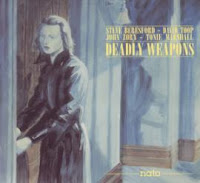
John Zorn - Deadly Weapons (1986)


STEVEN BERESFORD, DAVID TOOP, JOHN ZORN, TONIE MARSHALL
DEADLY WEAPONS (1986)
320 KBPS
Deadly Weapons is an album by Steve Beresford, John Zorn, Tonie Marshall and David Toop. The album was originally released on the Nato label in 1986. It is designed as film noir soundtrack music to a film which does not exist and could be considered a forerunner to Zorn's Spillane (1987).


1. Shockproof
2. Du Gris
3. King Cobra
4. Tallulah
5. Dumb Boxer
6. Lady Whirlwind
7. Shadow Boxer
8. Sitting in the Park
9. Snow Blood
10. Chen Pe'i Pe'i
11. Jane Mansfield


Download: Music

Monday, November 17, 2008

John Zorn_FilmworksXXI: Belle de Nature/The New Rijks (2008)


2008 proves a busy year for Zorn and film, with this, his third release of soundtrack music. FilmWorks XXI contains two very different film scores for two very different movies—one, a bit of French S/M erotica and the other a documentary about the renovation of the world-famed Rijksmuseum in Amsterdam. From baroque minimalism to a sensual fusion of harp, guitar and bass, the cues on FilmWorks XXI are some of the most unique and charming in the entire series, with Belle de Nature being one of Zorn's greatest scores to date.


Personnel:
Cyro Baptista: Percussion
Uri Caine: Harpsichord, Piano
Carol Emanuel: Harp
Marc Ribot: Guitar
Kenny Wollesen: Vibraphone, Chimes, Percussion
John Zorn: Harpsichord, Glass Percussion
Shanir Blumenkranz: Bass


Download: Music